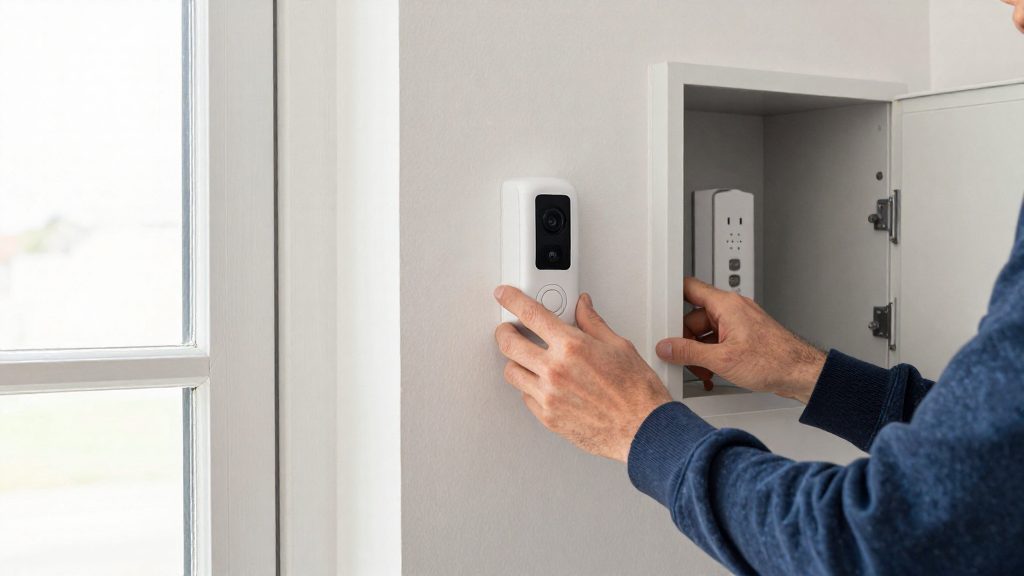
Video doorbell makers usually sell the hardware and earn recurring revenue from cloud services, such as stored video history and advanced alerts. Consumer Reports (2026-10-07) found that every doorbell on its no-subscription list stores footage locally, so a monthly fee is not required for basic recording on those models. Fees mainly attach to cloud history and to specific features.
How the cloud model creates recurring fees
In a cloud model, clips are uploaded to the manufacturer’s servers and kept for a period set by the plan. Longer retention and advanced features are sold as tiers, so the total cost depends on how long you keep the device, not only on its purchase price.
- Ring plans cost $5 to $20 per month. According to Consumer Reports (2026-10-07), this can add up to more than the price of the doorbell after a few years.
- To estimate your own cost, use: monthly fee × 12 × years of use. At Ring’s lowest rate, three years comes to $180. At the highest rate, it comes to $720.
Features gated behind subscriptions
Recording and alerting are separate functions, and manufacturers can charge for one while leaving the other free. Smart alerts are the clearest example.
| Model | Local storage (Consumer Reports, 2026-10-07) | Subscription status |
|---|---|---|
| Wyze Duo Cam | Up to 256 GB microSD | Smart alerts require Wyze Cam Plus |
| Tapo D205 | Up to 512 GB microSD | On the no-subscription list |
| Eufy E340 | 8 GB internal memory | On the no-subscription list |
The Wyze Duo Cam records to a microSD card without a fee, but its smart alerts are locked behind Cam Plus. Models without this gating show that the business model is a choice by each manufacturer, not a technical requirement.
Free AI detection as a comparison point
SlashGear (2026-10-18) reports that the Tapo D210 and D225 include AI detection at no extra charge. This shows that person or object detection can be offered without a monthly plan, which makes the subscription on competing models easier to evaluate.
What does no subscription really mean
A video doorbell with no subscription fee has no recurring monthly or annual charge for its core functions. It does not mean every feature is free, and it does not mean the footage is stored somewhere else.
Free means no recurring fee, not zero features
The purchase price and the ongoing cost are separate. “No subscription” addresses only the ongoing cost. A manufacturer can sell a device without a plan and still place some functions behind one.
Local recording and what it replaces
Local recording means clips are saved on the doorbell’s own storage, usually a microSD card, instead of being uploaded to a manufacturer’s cloud service. The trade-off is that footage stays with the device, so access depends on the physical hardware rather than an online account.
Features that stay free and limits that remain
| Feature | Status without a paid plan | Source |
|---|---|---|
| Local recording | Included on every model in the no-subscription list | Consumer Reports (2026-10-07) |
Remote live view from the app
The sources used here do not say whether remote live view from the app is free on each listed model. Check the manufacturer’s product page for live view before buying, and do not assume the answer carries over from another brand or another model in the same range.
Local storage options: microSD vs. internal vs. hub
A doorbell without a subscription keeps footage in one of three places: a microSD card inserted into the device, internal memory built into the doorbell, or a hub that expands storage for a set of cameras. Capacity varies widely between the three.
| Method | Models (publisher, date) | Stated storage |
|---|---|---|
| microSD slot | Tapo D205, TD25, D130 (Consumer Reports, 2026-10-07) | Up to 512 GB |
| microSD slot | Wyze Duo Cam (Consumer Reports, 2026-10-07) | Up to 256 GB |
| microSD slot | Eufy C31, Kasa KD110 (Consumer Reports, 2026-10-07) | Up to 128 GB |
| Internal memory | Eufy E340, Eufy S330 (Consumer Reports, 2026-10-07) | 8 GB |
| Internal memory | Many Eufy doorbells (SlashGear, 2026-10-18) | 8 to 16 GB |
| Hub expansion | Eufy HomeBase (SlashGear, 2026-10-18) | Up to 16 TB |
microSD offers the widest range of capacities among doorbells that stay free of a subscription. Consumer Reports lists up to 512 GB for the Tapo models, which is the highest microSD figure in this comparison; only the Eufy HomeBase hub goes higher, at up to 16 TB. Other brands sit lower: Lorex doorbells ship with a 32 GB SD card that can be upgraded to 256 GB, and the Reolink 2nd Gen battery doorbell supports up to 512 GB microSD (SlashGear, 2026-10-18).
Internal memory is the limiting factor. The Eufy E340 and S330 hold only 8 GB, and many Eufy doorbells offer 8 to 16 GB. At those sizes, the device overwrites older clips sooner than a card-based model would, so check the storage specification before buying.
A hub is the only option that multiplies capacity beyond the doorbell itself. The Eufy HomeBase expands Eufy storage up to 16 TB. SlashGear (2026-10-18) describes it as expensive and mainly suited to households with several Eufy cameras, so it rarely justifies its cost for a single doorbell.
Which video doorbells work without a subscription?
Consumer Reports (2026-10-07) publishes a list of video doorbells that store footage locally and do not require a paid plan. The list divides into two groups by installation method. Check the power and mounting requirements before buying, since they differ between the groups.
Wireless models (battery-powered, no doorbell wiring needed):
- Eufy C31
- Eufy E340
- TP-Link Tapo D205
- TP-Link Tapo TD25
- Wyze Duo Cam
Wired models (connected to existing doorbell wiring):
- Eufy S330
- Night Owl DB-DBW2
- Kasa KD110
- Tapo D130
Two Tapo models sit outside that list but suit a budget-focused buyer. According to SlashGear (2026-10-18), the Tapo D225 lists at $129.99 and was on sale at $99.99 at the time of its report. The Tapo D210 lists at $74.99. Confirm whether each model is wired or wireless on the manufacturer’s product page before purchase.
Wired or battery: which is better?
A wired doorbell draws continuous power from the existing doorbell circuit, so battery endurance is not a constraint. A battery model trades that constant supply for easier installation, but it must be recharged or have its battery replaced on a schedule. The right choice depends on whether the door already has working wiring and on which recording features you need. According to SlashGear (2026-10-18), the Tapo D225 has a battery rated for up to eight months, and the Reolink 2nd Gen battery doorbell has a rated battery life of 300 days.
These are manufacturer ratings. Actual endurance depends on how often the doorbell records and how many events it detects, so expect shorter real-world life on a busy entrance.
Battery power also affects which features you can use. Reolink’s pre-recording, which keeps footage from just before a motion trigger, requires a wired connection, so Reolink’s battery models do not offer it.
| Factor | Battery model | Wired model |
|---|---|---|
| Power source | Internal rechargeable battery | Existing doorbell wiring |
| Rated endurance | Up to eight months (Tapo D225); 300 days (Reolink 2nd Gen battery doorbell) | Not limited by a battery |
| Reolink pre-recording | Not available; requires a wired connection | Available |
| Installation prerequisite | None beyond mounting and Wi-Fi | Working doorbell chime wiring at the door |
Wired models depend on the existing doorbell chime wiring. If the wires are absent or damaged, a wired model cannot be installed as designed. Check the manufacturer’s installation requirements before buying, and confirm that the wiring at your door matches them.
Are there hidden costs with free doorbells?
A doorbell with no monthly fee can still carry upfront costs. Local recording depends on storage, and that storage is often a separate purchase. Some doorbells rely on a microSD card, while others use small built-in memory. The real cost of a setup is the doorbell, plus the storage it needs to record usefully, plus any accessory required for more than one camera.
Storage you buy separately
Several doorbells in this category depend on a microSD card sold separately. The Tapo D225 is one example: according to SlashGear (2026-10-18), its storage is a microSD card that is not included. Because the card is an extra purchase, the advertised doorbell price understates the cost of local recording. Check current card prices at your retailer and add them to the doorbell price before comparing models.
Built-in memory and the Eufy HomeBase
According to SlashGear (2026-10-18), many Eufy doorbells have only 8-16 GB of built-in storage. When that is not enough, the Eufy HomeBase can expand storage to 16 TB. SlashGear describes the HomeBase as expensive and mainly suited to people with several Eufy cameras, since its cost is shared across all of them. Confirm its price with the seller before treating it as part of the setup budget. For a single Eufy doorbell, the accessory’s cost is harder to justify than a card for a camera that accepts one.
Check whether the box includes a card
Storage in the box varies by brand, so confirm it before buying.
| Doorbell | Storage in the box | Extra purchase needed |
|---|---|---|
| Lorex (many models) | 32 GB SD card included | Optional upgrade to a larger card |
| Eufy (many models) | 8-16 GB built-in | HomeBase for expansion |
| Tapo D225 | No card included | microSD card, sold separately |
The Reolink 2nd Gen battery doorbell supports microSD storage, according to SlashGear (2026-10-18). Choosing a wired setup may require wiring work that was not in the original budget.
Smart home compatibility and privacy
Compatibility and privacy depend on two checks: how the doorbell connects to your ecosystem, and where its footage is stored.
Protocol and platform checks
Before buying, confirm the following against the manufacturer’s documentation, not the marketing page:
- Radio and hub requirements: Video doorbells are typically Wi-Fi devices. If a listing mentions Matter, Thread, Zigbee or Z-Wave, check whether that applies to the doorbell itself or only to an accessory such as a chime or sensor.
- Matter support: Look for an explicit Matter statement in the spec sheet. Matter-labelled doorbells are not automatically compatible with every hub.
- Voice assistants: Check the assistant’s own device list and whether the brand’s skill or integration is still maintained.
- Home Assistant: Look for an official integration or documented local stream. Without one, live view and events may depend on a vendor cloud service.
Where storage changes the privacy picture
| Storage type | Example | Privacy implication |
|---|---|---|
| Removable microSD card | Tapo D205, TD25, D130 (Consumer Reports, 2026-10-07) | Footage stays on the device and can be removed physically |
| Internal memory only | Eufy E340, S330 (Consumer Reports, 2026-10-07) | No card to remove; footage remains inside the unit |
| Cloud subscription | Ring plans at $5 to $20 per month (Consumer Reports, 2026-10-07) | Footage is held on vendor servers under the plan’s terms |
Frequently asked questions
Can I record video without paying a monthly fee?
Yes, on the models that Consumer Reports (2026-10-07) lists as no-subscription options, basic recording needs no plan. Footage is saved to a microSD card or internal memory, so the usable retention depends on capacity, which ranges from 8 GB on the Eufy E340 to 512 GB on the Tapo D205.
Which features can still require a paid plan on a no-subscription doorbell?
Recording and advanced alerts are billed separately, so a doorbell can record for free while extra functions sit behind a tiered plan. Before buying, check the manufacturer’s pricing page to confirm which alerts are included without payment.
Do lower-priced doorbells include AI detection without a plan?
Some do. SlashGear (2026-10-18) reports that the Tapo D210 ($74.99) and Tapo D225 ($129.99, or $99.99 on sale at the time of reporting) include AI detection at no extra charge. Prices and promotions change, so confirm the current cost and that the feature remains free before you buy.