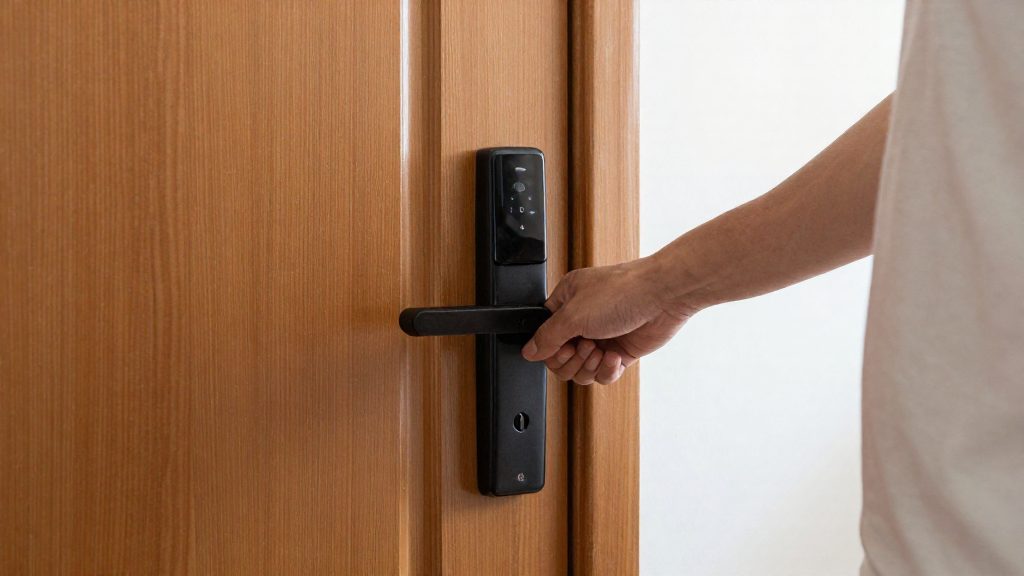
What counts as a smart lock for an existing deadbolt?
A retrofit lock is defined by what it leaves in place. The retained exterior hardware (outside handle or thumbturn, exterior escutcheon and key cylinder) stays where it is, and the device works with what is already there. Some designs, such as the Level Bolt, replace the internal housings and bolt, while others work over the existing bolt. Full-replacement locks, by contrast, swap out the complete assembly, which PCWorld contrasted with retrofit designs when it compared installation steps (PCWorld, 2024).
Retrofit products fall into a few groups, based on which part they replace:
| Product | What it installs on or replaces | What stays in place | Deadbolt limit |
|---|---|---|---|
| Level Bolt | Old internal housings and bolt inside the deadbolt | Exterior hardware and key cylinder | Works with many deadbolts, not all (Level Home, 2026) |
| August Retrofit Smart Lock | Mounts on the interior face over the existing deadbolt | Outside of the door unchanged | Single-cylinder deadbolts only (August Home, 2026) |
| Yale Approach Lock | Interior escutcheon only | Exterior hardware and keys | Most single-cylinder deadbolts (PCWorld, 2024) |
| Abode retrofit lock | Interior side of the deadbolt | Existing keys and exterior hardware | Any standard latch-style deadbolt (SecurityInfoWatch, 2024) |
Cylinder-replacing designs sit outside this retrofit scope because they change the key cylinder itself, so the exterior and key behaviour are no longer preserved.
Interior-only devices are the simplest category. Because the outside stays untouched, they fit only where the deadbolt’s interior mechanism is compatible.
Smart features retained after retrofit
- Automations and auto-lock rules: For Abode, geofencing and automations require a paid plan, at $6.99 a month for Standard or $21.99 a month for Pro (SecurityInfoWatch, 2024).
How do retrofit smart locks work?
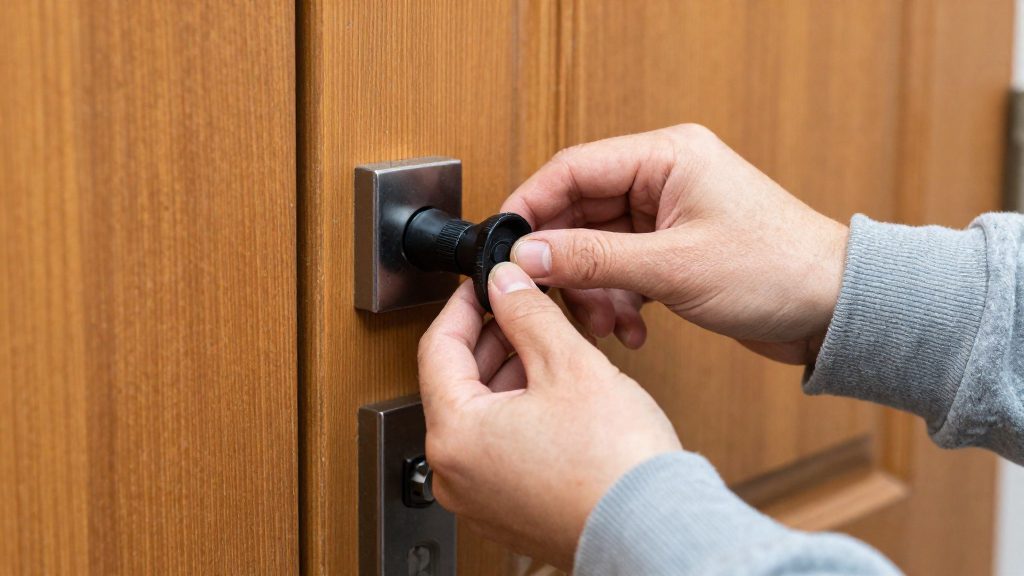
A retrofit smart lock keeps your exterior hardware and adds a motor unit. On some models, such as the August and Yale, the motor moves the existing bolt. On the Level Bolt, the motor unit replaces the old housings and bolt inside the door. The coupling adapter links the motor to the bolt, so the motor’s torque extends and retracts the bolt. On designs that operate the existing bolt, the original mechanical parts still do the locking, so the deadbolt must work properly before any electronics are added.
Motor drive through the coupling adapter
On the Level Bolt, the motor unit installs inside the existing deadbolt. The August Retrofit Smart Lock works differently: it mounts on the inside of the door over the existing deadbolt (August Home, 2026). The two designs differ: the August turns the existing deadbolt from the interior face, while the Level Bolt replaces the old housings and bolt with its own mechanism.
Battery power and runtime
The retrofit lock units described here run on batteries. The Abode retrofit lock, for example, has a rechargeable battery. The Abode retrofit lock uses a 4,000 mAh rechargeable battery rated for up to 12 months of average use (SecurityInfoWatch, 2024). The rating applies to average use only. For heavier use, check the manufacturer’s figures for your usage pattern.
Position sensing and auto-lock calibration
The lock needs to know where the bolt is so it can stop at the correct end of travel and report its state. Calibration establishes these reference positions, usually by running the bolt through its full range during setup. PCWorld (2024) reported that calibration on the Yale Approach was buggy, which made the lock unreliable during setup. Calibration results depend on the specific model, so follow the manufacturer’s setup instructions for the calibration procedure.
Will it fit my deadbolt?
A retrofit smart lock depends on two physical features of the existing deadbolt: its cylinder count and its internal tailpiece geometry. A single-cylinder deadbolt has a keyed cylinder on the outside and a turn knob inside. A double-cylinder deadbolt is keyed on both sides. Retrofit products differ in which of these they accept, so the first check is the cylinder type, and the second is whether the tailpiece engages the device’s drive mechanism.
Single-cylinder versus double-cylinder
Compatibility statements vary by product:
- August Retrofit Smart Lock: works only with single-cylinder deadbolts (August Home, 2026).
- Yale Approach Lock: works with most single-cylinder deadbolts (PCWorld, 2024).
- Level Bolt: works with many deadbolts, but not all (Level Home, 2026).
- Abode retrofit lock: fits the interior side of any standard latch-style deadbolt (SecurityInfoWatch, 2024).
For each product, the manufacturer’s wording is the reference point, so do not assume a match from the cylinder type alone.
Tailpiece alignment and double-tail deadbolts
The tailpiece is the internal bar that the deadbolt’s mechanism turns. If it does not line up with the retrofit’s drive, the device cannot operate the bolt. PCWorld’s reviewer found that a Kwikset double-tail deadbolt was incompatible with the Yale Approach Lock because the tailpiece did not align (PCWorld, 2024). Matching the brand or the exterior appearance does not confirm tailpiece compatibility.
Verified-compatibility lists and model checks
Manufacturers publish the references needed for a model check:
| Product | Stated deadbolt compatibility | Verification route |
|---|---|---|
| Level Bolt | Many deadbolts, not all | Level’s verified-compatibility list; Level advises checking with the manufacturer (Level Home, 2026) |
| August Retrofit Smart Lock | Single-cylinder deadbolts only | August’s compatible-model list (August Home, 2026) |
| Yale Approach Lock | Most single-cylinder deadbolts | Tailpiece mismatch found on a Kwikset double-tail model (PCWorld, 2024) |
| Abode retrofit lock | Any standard latch-style deadbolt | Manufacturer description (SecurityInfoWatch, 2024) |
To check a specific door, record the exact brand and model number of the existing deadbolt, confirm the cylinder type, and search the manufacturer’s list for that model. If the model is not listed, contact the manufacturer before buying.
Retrofit lock options compared
The three retrofit designs differ mainly in how much of the existing deadbolt they replace. The Level Bolt installs inside the deadbolt itself. The August Retrofit Smart Lock takes the opposite approach: it mounts on the interior face of the door over the existing deadbolt (August Home, 2026). The Yale Approach Lock has the narrowest scope, replacing only the interior escutcheon (PCWorld, 2024).
| Model | Interior change | Exterior hardware | Deadbolt scope |
|---|---|---|---|
| Level Bolt | Old housings and bolt removed; Bolt inserted within the deadbolt | Kept | Works with many deadbolts, not all |
| August Retrofit | Lock mounted over the existing deadbolt | Unchanged | Single-cylinder deadbolts only |
| Yale Approach | Interior escutcheon replaced | Kept | Most single-cylinder deadbolts |
Practical constraints of each design
- Level Bolt: Because the mechanism sits inside the existing deadbolt, the most invasive interior work is removing the original parts.
- Yale Approach: It has the narrowest scope, replacing only the interior escutcheon, but PCWorld found installation takes about twice as many steps as a full-replacement lock. PCWorld could not recommend it and pointed to the Level Bolt instead.
Can I keep my keys?
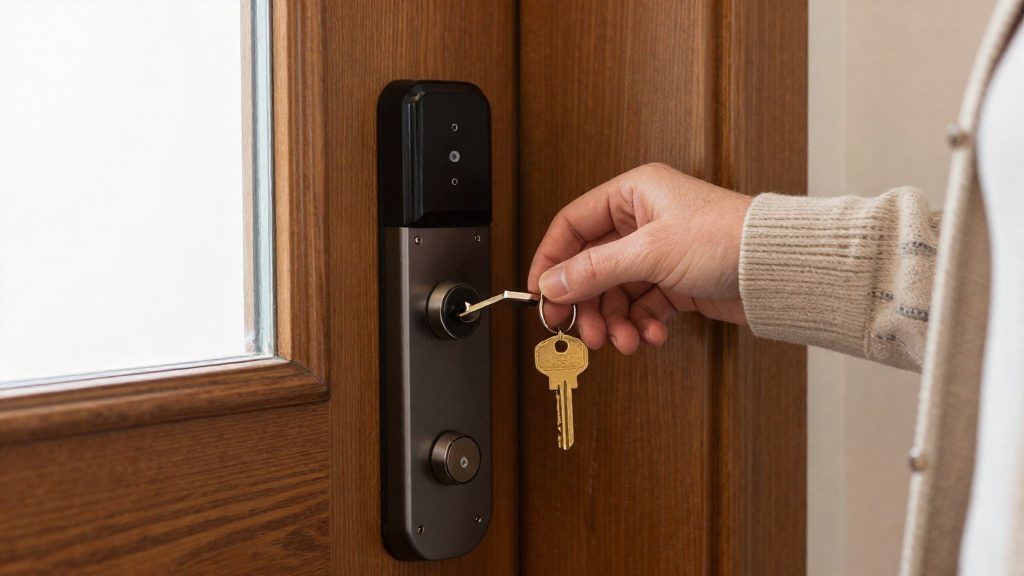
Yes. The models in this group keep the physical key cylinder, so your metal keys still turn the lock. The smart mechanism sits inside the door or on its interior side, and the cylinder continues to handle the physical key. What changes is everything else: the credentials you use to open the door. Level Key Fobs and Key Cards, for example, do not work with the Level Bolt, so access moves to a keypad, a phone app, or codes.
Which models keep the key cylinder
| Model | What it changes | Physical key still works? | Compatibility limit |
|---|---|---|---|
| Level Bolt | Replaces the old deadbolt housings and bolt inside the door, keeping the exterior hardware and key cylinder (Level Home, 2026) | Yes | Works with many deadbolts, not all; check Level’s verified-compatibility list |
| August Retrofit Smart Lock | Mounts on the inside over the existing deadbolt; outside is unchanged (August Home, 2026) | Yes | Single-cylinder deadbolts only |
| Yale Approach Lock | Replaces only the interior escutcheon (PCWorld, 2024) | Yes | Most single-cylinder deadbolts |
| Abode retrofit lock | Fits the interior side of a standard latch-style deadbolt (SecurityInfoWatch, 2024) | Yes | Standard latch-style deadbolts |
What replaces keys
Access moves to the lock’s own input methods:
- Keypad PIN and fingerprint: The Abode keypad supports PIN and fingerprint entry and connects over Bluetooth (SecurityInfoWatch, 2024).
- Guest PINs: Abode offers one-time and scheduled guest PINs (SecurityInfoWatch, 2024), which suit visitors and cleaners.
Installation, clearance and bridge requirements
Retrofit smart locks fit over or inside an existing deadbolt, so three factors decide whether a model suits a given door: interior clearance, the tools required, and where a Wi-Fi bridge can be placed. The Level Bolt installs inside the existing deadbolt and the August Retrofit Smart Lock mounts on the interior face. Both leave the exterior hardware in place, but their space demands and installation effort differ.
Interior door clearance
Clearance is the main physical constraint for interior-mounted models. According to August Home (2026), the door needs enough interior space for the lock’s wing latches to extend fully, and the required space varies by model. Check August’s space guide and compatible-model list before buying, since the requirement is model-specific.
Tools and installation time by model
Level Bolt and the August Retrofit Smart Lock have the most clearly documented installation steps:
| Model | Tools | Installation |
|---|---|---|
| Level Bolt | Screwdriver only, no drill | Remove old housings and bolt, insert the Bolt, fit one of three included adapters (Level Home, 2026) |
| August Retrofit Smart Lock | Phillips screwdriver | Under 10 minutes, according to August Home (2026) |
PCWorld (2024) found that installing the Yale Approach takes about twice as many steps as a full-replacement lock, which makes it more labour-intensive to install than a full-replacement lock.
Wi-Fi bridge placement and signal
Bridge requirements differ by brand. PCWorld (2024) found that the Yale Approach needs a Wi-Fi bridge in an outlet within 30 feet of the lock.
The sources cited here do not give signal-strength figures, so measure the distance from the nearest outlet to the door and compare it against the manufacturer’s stated bridge requirements.
Matter, Wi-Fi and smart home compatibility
Retrofit locks join a smart home through one of two paths: a Wi-Fi bridge placed near the door, or a direct link to an app or hub. The path determines whether you can lock and unlock remotely, run automations, or control the lock from a voice assistant. The table lists the connection requirements stated for each model.
| Lock | Connection requirement | Remote and automation access |
|---|---|---|
| Level Bolt | Level Connect Wi-Fi bridge or hub integration | Remote access needs one of these (Level Home, 2026) |
| Yale Approach Lock | Wi-Fi bridge in an outlet within 30 feet of the lock | Bridge required (PCWorld, 2024) |
| Abode retrofit lock | Wi-Fi-enabled lock; keypad connects over Bluetooth | Geofencing and automations need a paid plan: $6.99 a month (Standard) or $21.99 a month (Pro) (SecurityInfoWatch, 2024) |
Matter support is a per-model claim. The connection requirements above do not establish it, so check the manufacturer’s product page or packaging for a stated Matter certification before you buy. Do not assume a lock supports Matter because its brand supports Matter on other products.
Hub integration is the second route. Level Bolt lists hub integration as a remote-access option but does not name the platforms it supports here. Confirm with Level whether Home Assistant or your voice assistant is supported before you plan automations around either.
Local control versus cloud dependence
Local control means commands run on your home network or directly between devices, without a remote server. Cloud dependence means they pass through the manufacturer’s servers. Test this on your own setup:
- Disconnect the bridge or switch off the lock’s Wi-Fi, then check whether the keypad or key still operates the bolt.
- Use the Abode keypad to confirm the Bluetooth link works without internet access, since Bluetooth operates over short range.
- Check whether automations and geofencing still run when the internet connection drops.
Retrofit or full replacement?
A retrofit lock suits a door whose existing deadbolt is sound and within the lock’s design limits. Full replacement is the better route when the deadbolt is incompatible or worn. The decision turns on fit, security and control, and each retrofit design relies on different parts of the existing hardware.
When retrofit beats full replacement
A retrofit keeps the exterior hardware in place, so it fits doors where the existing deadbolt works. Choose a retrofit when you want the door’s exterior appearance and hardware left unchanged.
When full replacement is required
Retrofit compatibility is not universal.
| Condition | Retrofit outcome | Source |
|---|---|---|
| Deadbolt is not single-cylinder | August Retrofit Smart Lock works only with single-cylinder deadbolts | August Home (2026) |
A stiff or misaligned bolt should be repaired or replaced before any retrofit is fitted.
Security trade-offs
A retrofit keeps the original exterior cylinder and bolt, so any weakness in them remains. An integrated replacement lock swaps the whole unit, which removes that dependency but also removes the original exterior hardware. A retrofit’s remaining weak point is the original exterior hardware and key cylinder, plus the existing bolt on designs that operate it (such as the August). The Level Bolt replaces the bolt, but not the exterior parts. Check the condition of whatever stays in place before choosing a retrofit over a full replacement.