Does ecobee work with a heat pump in Canada?
ecobee states that its thermostats work with over 90% of 24V systems, and that this includes high-rise heat pump systems. ecobee’s claim covers 24V systems in general, so it does not by itself confirm that a given heat pump installation is compatible. The claim has limits, though. Compatibility depends on the wiring, the equipment type and the stage count, not on a brand label.
Does ecobee work with a heat pump in Canada?
Where the compatibility claim applies
| System type | ecobee’s position (ecobee Canada, 2026) |
|---|---|
| 24V systems | Over 90% are compatible |
| High-rise heat pump systems | Covered by the compatibility claim |
Where compatibility stops
- Cold weather: compatibility with the thermostat does not replace the outdoor unit’s low-temperature rating.
Which ecobee models support which heat pump stages
According to ecobee Canada (2026), the Premium and Lite thermostats support heat pumps with up to 4 heat stages and 2 cool stages (4H/2C). The Enhanced supports up to 3 heat stages and 2 cool stages (3H/2C). Each heat stage or cool stage is a separate output the thermostat can control, so the model’s limit must be at least the number of stages on the installed heat pump.
| Model | Heat stages (heat pump) | Cool stages (heat pump) |
|---|---|---|
| ecobee Premium | 4 | 2 |
| ecobee Lite | 4 | 2 |
| ecobee Enhanced | 3 | 2 |
Auxiliary heat limit on Enhanced
Auxiliary heat is the backup heat source that runs when the heat pump alone cannot meet demand. On heat pump systems, the Enhanced does not support two stages of auxiliary heat, according to ecobee Canada (2026). A home whose heat pump setup relies on two auxiliary stages should not assume the Enhanced can run that configuration without confirming it with an installer first.
For models not listed in the table, check the stage limits on ecobee’s Canadian contractor page or on the product label.
Do you need a C wire or Power Extender Kit?
The C wire (common wire) completes the 24V control circuit between the HVAC equipment and the thermostat. Its main job is to supply continuous power to the thermostat’s electronics, including the Wi-Fi radio and touchscreen, without relying on the heating or cooling control wires. Without it, the thermostat must draw power in other ways, which can be unreliable on some systems.
When a home has no C wire, the Power Extender Kit is ecobee’s answer. According to ecobee Canada (2026), the kit helps when there is no C wire, and some installations require it. Availability depends on the model:
| Model | Power Extender Kit |
|---|---|
| Premium | Included |
| Enhanced | Included |
| Lite | Sold separately |
To check whether your system has a C wire before buying:
- Turn off power to the HVAC system at the breaker or furnace switch.
- Open the furnace or air handler cover, or the heat pump’s indoor control board, and look for a terminal labelled C.
- Check the existing thermostat cable for a spare conductor that is not connected to a terminal at the thermostat.
Can ecobee control a variable-speed heat pump?
Yes, but only with an adapter. According to ecobee Canada (2026), modern variable-speed (inverter) heat pumps need an adapter to work with ecobee thermostats. Inverter units vary compressor speed instead of switching in fixed stages, so the thermostat’s standard signals don’t map directly to the heat pump, and the adapter translates between the two.
Who supplies the adapter
Adapters come from two sources:
- HVAC manufacturers, which sell an adapter matched to their own inverter models.
- Third-party vendors, which make adapters for use with a range of heat pumps.
The adapter has to match both the heat pump and the ecobee model, so confirm the pairing before buying. Ask the heat pump maker or installer for the exact adapter model and check it against the heat pump’s documentation.
Professional installation
ecobee Canada (2026) recommends a professional install, ideally at the same time as the heat pump installation. Installing both together lets the installer add the adapter, check the wiring, and configure the thermostat for the system in one visit.
How to set up a heat pump in ecobee
Setting up a heat pump on an ecobee thermostat follows a fixed sequence: confirm the model and its stage limits, wire the system against that model’s documentation, power up and choose the heat pump equipment type, then set heat and cool stages to match the outdoor unit.
Step 1: Confirm the model and its stage limits
Identify your model before any wiring, because the stage limits differ.
Step 2: Check the heat pump type
Confirm the unit type from the outdoor unit’s nameplate or the manufacturer’s documentation before continuing.
Step 3: Match each wire to the model’s documentation
- Lite: use the wiring diagram published for the Lite model.
- Premium and Enhanced: use the pro install and configuration guide.
Switch off power at the breaker first, then label each conductor at the furnace or air handler before removing it from the old thermostat. Do not assume that a wire’s colour dictates its terminal. Terminal assignments for heat pump operation, including the reversing valve setting, vary by model and equipment, so take them from the wiring diagram or pro install guide for your specific model.
Step 4: Power down and mount
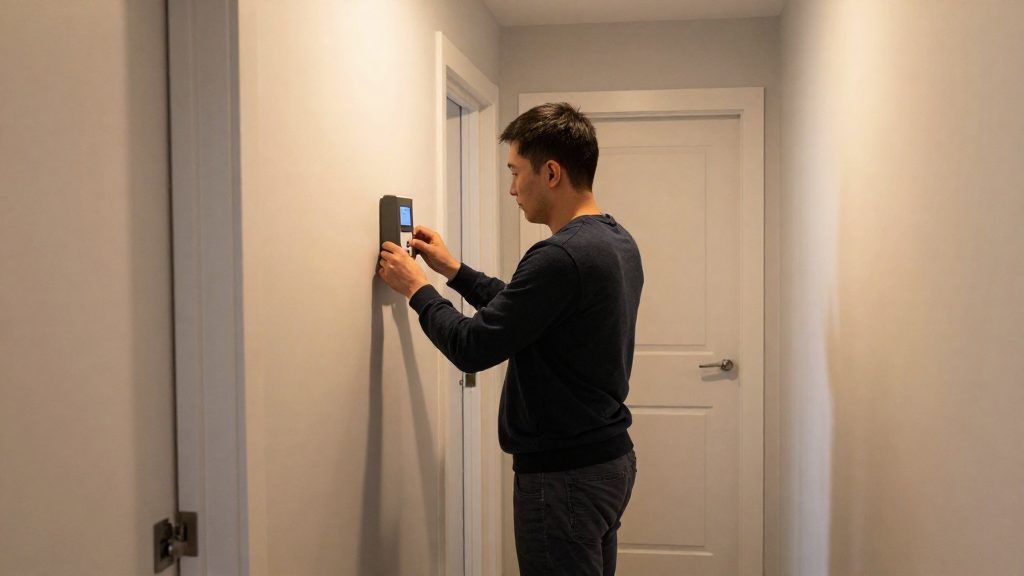
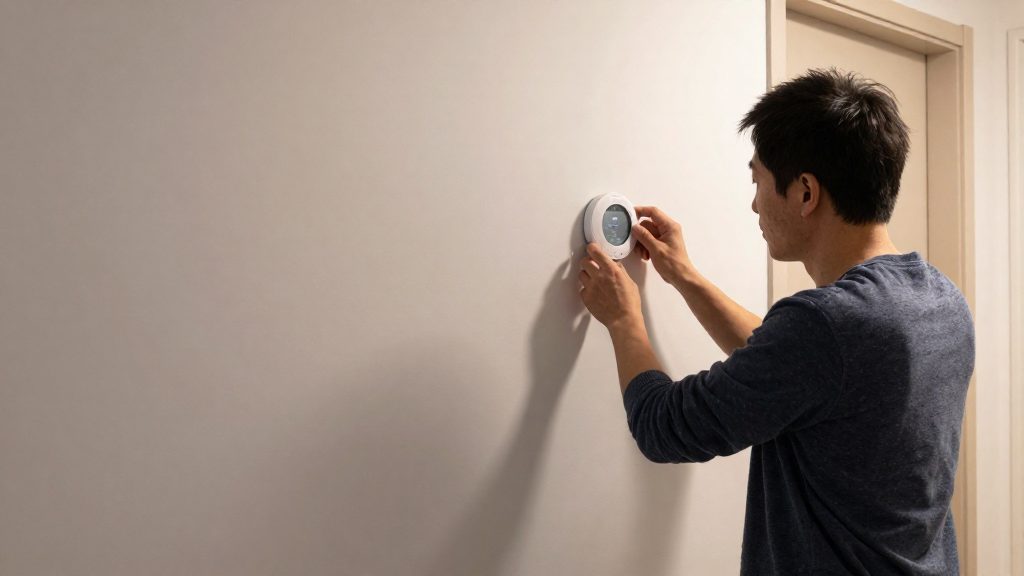
Switch off power at the breaker before connecting or disconnecting any wire. Mount the thermostat and power it up only after every conductor is seated. The install video for your model shows the mounting and power-up sequence.
Step 5: Select the heat pump system type
During initial setup, choose the heat pump equipment option when the setup prompts for system type. If the installation guide asks for a reversing valve setting, enter the value it specifies for your unit type.
Step 6: Set heat and cool stages
Enter the number of stages that the outdoor unit and indoor components actually provide. Entering more stages than the equipment has can cause the thermostat to call for stages the system cannot run. Use the manufacturer’s rated stage count, not the maximum the thermostat supports.
Step 7: Test each mode
Run heat and cool separately, then confirm the outdoor unit responds to each stage the thermostat calls. A heat pump that cools when set to heat, or does not change stages, indicates a wiring or type setting to recheck against the model’s guide.
Cold climate, backup heat and dual fuel
ecobee advises pairing a heat pump with a cold-climate unit rated to about −30°C for Canadian winters. For the coldest days, it recommends backup electric resistance heat or the existing furnace. The heat pump carries the load in moderate cold, and the backup source takes over when outdoor temperatures fall below what the heat pump can deliver (ecobee Canada, 2026).
Cold-climate rating
A cold-climate heat pump is designed to keep producing heat at low outdoor temperatures. ecobee’s guidance targets units rated to about −30°C. Confirm the low-temperature rating on the manufacturer’s data sheet for your exact outdoor unit, since the rating is a property of that unit, not of the thermostat.
Backup heat sources
| Backup source | Role on the coldest days |
|---|---|
| Backup heat (electric resistance) | Supplements or replaces heat pump output when it is not enough |
| Existing furnace | Provides heat when the heat pump is below its useful range |
Switchover logic
The thermostat hands off between sources based on the installer’s configuration, not on a fixed setting you choose yourself:
- The heat pump runs first across its rated operating range.
- When outdoor conditions exceed that range, the backup source is enabled.
- Once conditions improve, the heat pump resumes as primary heat.
Which backup source is active, and at what conditions it engages, depends on how the system was installed and configured.
For dual fuel setups (a heat pump paired with a fossil-fuel furnace), confirm support for your exact ecobee model before buying equipment.
Are there rebates for a heat pump in Canada?
Rebate eligibility for a heat pump in Canada varies by program. According to ecobee Canada (2026), an oversized unit can disqualify a home from rebates, and an energy audit can help with qualifying.
Why sizing can disqualify a home
An oversized heat pump is the first condition to check. According to ecobee Canada (2026), an oversized unit can disqualify a home from rebates. Program rules differ, so check how each program assesses sizing before choosing a unit. Ask the installer for the load calculation and the rated capacity of the proposed unit before signing a quote, and confirm that the sizing report is what the rebate application will use.
The role of the energy audit
An energy audit is the step that establishes the home’s heating load and efficiency baseline. ecobee Canada (2026) states that an audit can help with qualifying for rebates. Because the audit results feed into the sizing decision, it is practical to book it before selecting a heat pump, not after installation.
Provincial rebates and incentives
Many provinces offer rebates or incentives for heat pump installations, but no single national schedule applies. Check the following for each province:
- Current program name and administering body
- Eligible equipment list and minimum efficiency ratings
- Whether the program requires a pre-approval before installation
- Whether the application requires a contractor’s sizing report or an energy audit
- Application deadlines and whether funding is still available
When to call an HVAC pro
A licensed HVAC technician is needed when the heat pump wiring does not match the ecobee wiring plan, when the heat pump’s stage count exceeds what the chosen thermostat supports, or when faults return after configuration is complete.
Mismatched or unknown wiring at the heat pump terminals
Stop before connecting any wire if the terminal labels on the heat pump or air handler cannot be matched to the ecobee wiring diagram for your model, or if a wire has no identified function.
If the home has no C wire, ecobee says its Power Extender Kit helps, that it is included with Premium and Enhanced, that it is sold separately for Lite, and that some installations require it (ecobee Canada, 2026). If you are unsure how to run or connect it, ask a technician.
Stage count outside the thermostat’s limits
If the heat pump has more stages than the model supports, or if an Enhanced would need two stages of auxiliary heat, the mismatch requires a technician’s assessment before wiring.
Variable-speed (inverter) heat pumps should be treated as a technician job by default.
Repeated faults after configuration
Call a technician when the system keeps producing the same fault after you have rechecked the settings and wiring. Common signs include short cycling, failure to switch between heating and cooling, or an error that clears after a reset and returns. Repeated resets that clear a fault without identifying its cause are a reason to stop and call for service.
Before the visit, record the error code, the operating mode, and the outdoor temperature when the fault occurs. This gives the technician a reproducible case to diagnose.
Using ecobee Canada’s contractor page
When you contact an installer from ecobee’s Canadian contractor page, ask three questions:
- Have they installed ecobee thermostats on heat pump systems?
- Will they check the heat pump terminal labels against the ecobee wiring diagram before connecting anything?
- Do they know the stage limits of your ecobee model?